
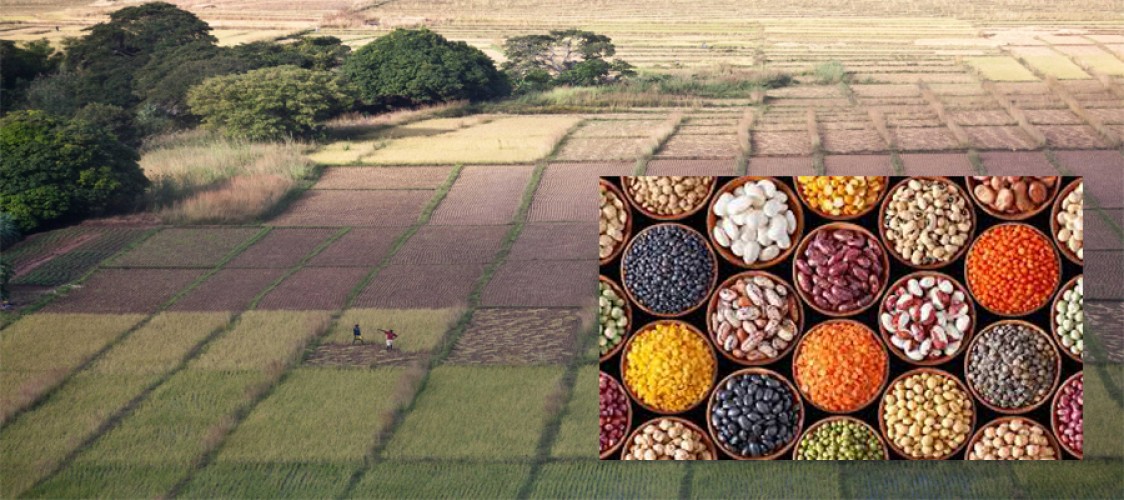
File photo
Agriculture is one of the bases of Argentina's economy. Argentine agriculture is relatively capital-intensive, providing about 7% of all employment as of 2013 and, even during its period of dominance around 1900, accounting for no more than a third of all labor. Having accounted for nearly 20% of GDP as late as 1959, it adds, directly, less than 10% today. Agricultural goods, whether raw or processed, earn over half of Argentina's foreign exchange and arguably remain an indispensable pillar of the country's social progress and economic prosperity. An estimated 10-15% of Argentine farmland is foreign-owned. One fourth of Argentine exports of about US$86 billion in 2011 were composed of unprocessed agricultural primary goods, mainly soybeans, wheat, and maize. A further one-third was composed of processed agricultural products, such as animal feed, flour, and vegetable oils. The national governmental organization in charge of overseeing agriculture is the Secretariat of Agriculture, Cattle Farming, Fishing and Food (Secretaría de Agricultura, Ganadería, Pesca y Alimentos, SAGPyA).

Argentina's agricultural production in 2018
Argentina is the largest producer in the world of yerba mate, one of the 5 largest producers in the world of soy, maize, sunflower seed, lemon and pear, one of the 10 largest producers in the world of barley, grape, artichoke, tobacco and cotton, and one of the 15 largest producers in the world of wheat, sugarcane, sorghum and grapefruit.
In 2018, Argentina was the 4th largest producer of beef in the world, with a production of 3 million tons (behind only the USA, Brazil, and China). It was also the 3rd largest producer of soy in the world, with 37.7 million tons produced (behind only the USA and Brazil); the 4th largest producer of maize in the world, with 43.5 million tons produced (behind only the USA, China and Brazil); the 12th largest producer of wheat in the world, with 18.5 million tons produced; the 11th largest producer in the world of sorghum, with 1.5 million tons produced; the 10th largest producer of grape in the world, with 1.9 million tons produced; and the 3rd largest producer of honey in the world, with a production of 79 thousand tons (behind only China and Turkey), besides having produced 19 million tons of sugarcane, mainly in the province of Tucumán[9] - Argentina produces near 2 million tons of sugar with the produced cane. In the same year, Argentina produced 4.1 million tons of barley, being one of the 20 largest producers in the world of this cereal. The country is also one of the world's largest producers of sunflower seed: in 2010, it was the 3rd largest producer in the world with 2.2 million tons. In 2018, Argentina also produced 2.3 million tons of potato, almost 2 million tons of lemon, 1.3 million tons of rice, 1 million tons of orange, 921 thousand tons of peanut, 813 thousand tons of cotton, 707 thousand tons of onion, 656 thousand tons of tomato, 565 thousand tons of pear, 510 thousand tons of apple, 491 thousand tons of oats, 473 thousand tons of beans, 431 thousand tons of tangerine, 302 thousand tons of yerba mate, 283 thousand tons of carrot, 226 thousand tons of peach, 194 thousand tons of cassava, 174 thousand tons of olives, 174 thousand tons of banana, 148 thousand tons of garlic, 114 thousand tons of grapefruit, 110 thousand tons of artichoke, in addition to smaller productions of other agricultural products.


In 2025, the five largest business groups dedicated to agriculture in Argentina, measured by planted area, represent the consolidation of a sector that combines family tradition with strategic expansion. Aceitera General Deheza (AGD), owned by Roberto Urquía, leads the ranking with approximately 300,000 hectares, experiencing 50% growth over the last five years, operating through a combination of owned and leased fields and in partnership with third-party producers. Lartirigoyen ranks second with 280,000 hectares after jumping from 154,000 hectares in the 2020/2021 season, notable for operating exclusively under an associative model. In third place is MSU Agro, owned by Manuel Santos Uribelarrea Balcarce, which expanded its operations to 220,000 hectares, with annual grain production of 1.1 million tons. Fourth place goes to Adecoagro with 159,125 hectares, while fifth place belongs to LIPSA, led by Cristian Moudjoukian, with 145,000 hectares, representing new players that have gained prominence in the sector.
Organic agriculture
Argentina is a world leader in organic agriculture, a production category that excludes synthetic fertilizers, pesticides, and GMOs. Argentina has a reported 3,061,965 hectares of certified organic production land, and it is second only to Australia, followed by the United States.
Labor practices
According to a report published by the Bureau of International Labor Affairs in December 2014, significant incidence of child labor and forced labor has been recorded and included in a List of Goods Produced by Child Labor or Forced Labor mentioning Argentina as a country where cotton, garlic, grapes, olives, strawberries, tobacco, tomatoes and yerba mate are produced in such working conditions.
Source: Online/GFMM
















































Copyright © 2026 LIMRA Exhibitions. All Right Reserved.
Website Design & Development ♡ MY SOFT IT