
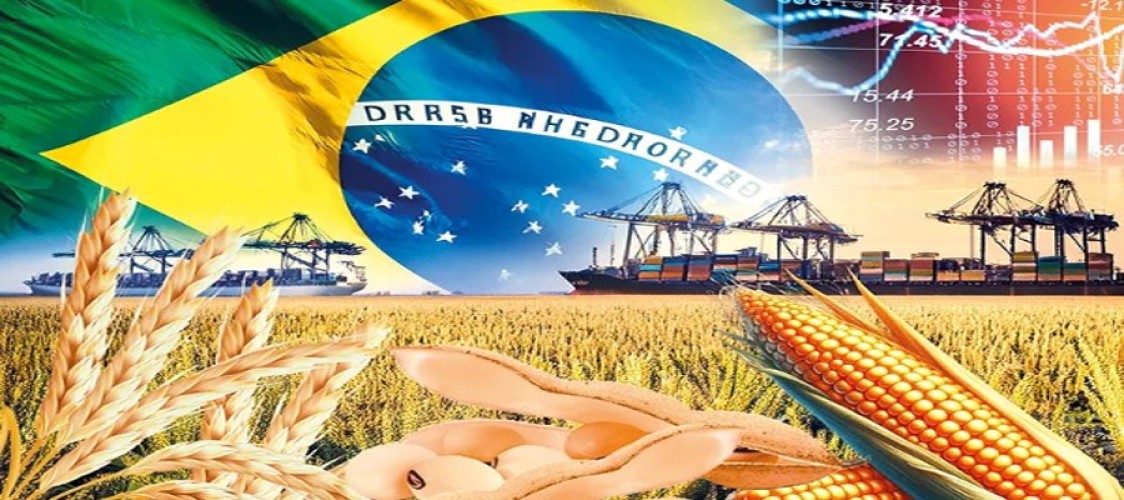
File photo
The air of Brazil is very healthy, fresh, and temperate, like that of Entre Douro e Minho. Two climates are found to be similar in one season. There is an abundance, an infinite quantity of water. The country is so fertile that if it were properly cultivated, everything would yield because of its water. But this water, soil, and climate have made Brazilian agriculture much richer. Brazil's agricultural production relative to the world was selected based on agricultural production in 2018.
*It was by far the largest world producer of sugarcane (746.8 million tons). The 2nd place, India, produces about half of Brazil's production (376.9 million tons). Brazil uses much of the cane to produce ethanol, in addition to exporting a lot of sugar.
*It was the 2nd largest world producer of soy (117.8 million tons), second only to the United States. However, Brazil surpassed US soybean production in 2020.;
*It was the 3rd largest world producer of maize (82.2 million tons), third only to the US and China;
*It was the 5th largest world producer of cassava (17.6 million tons), fifth only to Nigeria, Thailand, Congo, and Ghana;
*It was the largest world producer of oranges (16.7 million tons);
*It was the 9th largest world producer of rice (11.7 million tons);
It was the 3rd largest world producer of bananas (6.7 million tons), third only to India and China. If we also consider the plantains, Brazil is the 7th largest producer.
*It produced 5.4 million tons of wheat;
*It was the 4th largest world producer of cotton (4.9 million tons), losing only to India, the USA, and China;
*It was the 10th largest world producer of tomatoes (4.1 million tons);
*It produced 3.6 million tons of potatoes;
*It was the world's largest producer of coffee (3.5 million tons);
*It was the largest world producer of guaraná (3.3 million tons);

*Produced 3.2 million tons of legume;
*It was the 3rd largest world producer of beans (2.9 million tons), third only to Myanmar and India;
*It was the 3rd largest world producer of pineapple (2.6 million tons), only after Costa Rica and the Philippines;
*It was the 5th largest world producer of coconut (2.3 million tons), losing to Indonesia, the Philippines, India, and Sri Lanka;
*It was the 4th largest world producer of watermelon (2.3 million tons), losing to China, Iran,n and Turkey;
*It was the 7th largest world producer of sorghum (2.2 million tons);
*It was the 7th largest world producer of mango (including mangosteen and guava) (1.9 million tons);
*It was the 14th largest world producer of grapes (1.6 million tons);
*It was the 14th largest world producer of onions (1.5 million tons);
*Produced 1.5 million tons of palm oil;
*It was the 5th largest world producer of lemon (1.4 million tons), losing to India, Mexico, China, and Argentina;
*It was the largest world producer of açaí (1.3 million tons);[14]
*It was the 13th largest world producer of apples (1.1 million tons);
*It was the 2nd largest world producer of papaya (1 million tons), second only to India;
*Produced 996 thousand tons of tangerine;
*Produced 897 thousand tons of oats;
*It was the 2nd largest world producer of tobacco (762 thousand tons), second only to China;
*It produced 741 thousand tons of sweet potato;
*It was the 14th largest world producer of peanuts (563 thousand tons);
*It produced 546 thousand tons of yerba mate;
*It produced 330 thousand tons of barley;
*It was the 6th largest world producer of cocoa (239 thousand tons);
*It was the 6th largest world producer of avocado (235 thousand tons);
*Produced 199 thousand tons of natural rubber;
*It was the 6th largest world producer of persimmon (156 thousand tons);
*It was the 9th largest world producer of cashew nuts (141 thousand tons);
*It produced 135 thousand tons of sunflowers;
*It was the largest world producer of Brazil nuts (36 thousand tons);
*In addition to smaller productions of other agricultural products.
Source: Online/GFMM



















































Copyright © 2026 LIMRA Exhibitions. All Right Reserved.
Website Design & Development ♡ MY SOFT IT