
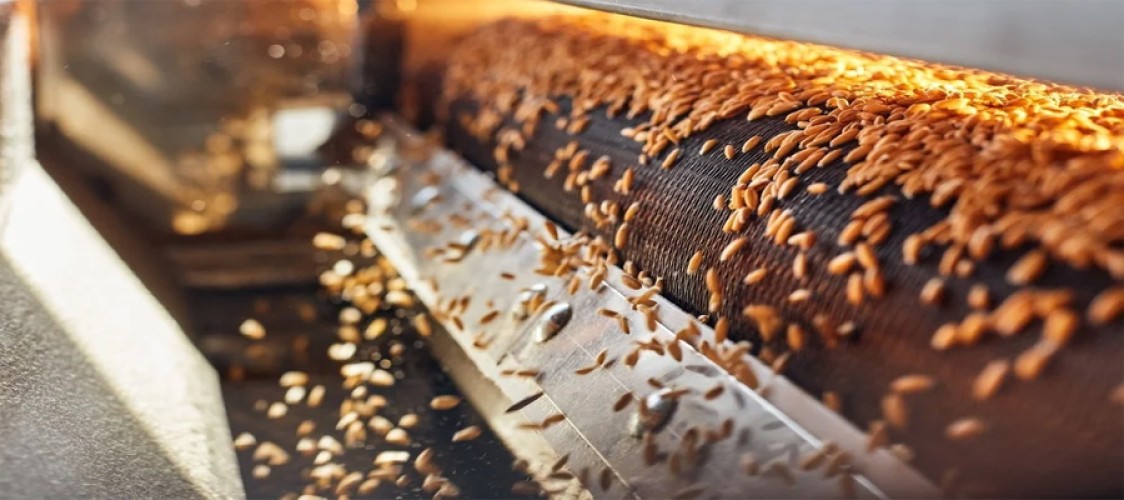
File photo
Global grain technology represents a spectrum from advanced, AI-driven precision agriculture in developed regions to traditional, biodiversity-focused farming in developing nations. Key innovations include digital, GPS-guided farming, genetic modification (GM) for climate resilience, and automated, AI-based, roller-milling, and sorting systems. The diversity of grain technology is currently characterized by a duality between high-tech industrial systems focused on maximizing yields of a few staple crops and a growing movement to revive genetic diversity through ancient grains and decentralized digital tools.
For centuries, ancient grains fed populations, but due to their low yield, they were abandoned and replaced by high-yielding species. However, currently, there is a renewed interest in ancient wheat and pseudocereal grains from consumers, farmers, and manufacturers. Ancient wheat such as einkorn, emmer, spelt, and Kamut® is being reintegrated because of its low fertilizer input, high adaptability, and important genetic diversity. New trends in pseudocereal products are also emerging, and they are mostly appreciated for their nutritional outcomes, particularly by the gluten-free market. Toward a healthier lifestyle, ancient-grain-based foodstuffs are a growing business, and their industrialization is taking 2 pathways: either as a raw ingredient or a functional ingredient. This paper deals with these grain characteristics by focusing on the compositional profile and the technological potential.

1. Core Production & Genetic Technology
With the ongoing East African drought crisis, the persisting threat of global climate change, and the world population now estimated at 7 billion, global concerns about food insecurity are again in the news. Little mentioned, however, is the continuing loss of genetic diversity of the foods we eat today—a trend that has rapidly accelerated since the twentieth century and that raises troubling questions about the vulnerability of the world's food supply. One attempt to maintain plant biodiversity has been the establishment of gene banks—giant vaults to store seeds collected from around the globe. But there are serious questions over whether the collection of seeds from ancient Mesopotamian wheat, South American potatoes, or tropical plants in an isolated arctic catacomb can undo a recent history of agriculture that has emphasized bigger yields through modern, standardized varieties of crops.
Modern grain production is dominated by a few "powerhouse" species—wheat, rice, and maize—which provide 95% of human food energy needs
Genetic Editing (CRISPR): Researchers use CRISPR and gene mapping to introduce traits from wild wheat relatives, improving nutritional value and resilience against climate-induced stressors.
Hybridization & Breeding: Global organizations like CIMMYT develop semi-dwarf, high-yield varieties that now cover 50% of the world's wheat fields.
Ancient & Heritage Grains: To counter the loss of genetic diversity, there is a global push to reintegrate grains like teff, fonio, and millets, which are naturally drought-tolerant and rich in micronutrients.

2. Digital & Precision Agriculture (Agriculture 4.0)
Food is a basic necessity of human life, and the stability of grain production directly affects everyone's right to survival and health. It is crucial to ensure the basic living needs of the global population (Chin et al., 2024). As a populous country, China has always attached great importance to grain production. Since 2021, the Chinese government has set an annual grain production target of over 65 million tons for four consecutive years (Wang et al., 2024). China's total grain production remains the world's largest, maintaining a high level of over 600 million tons for nine consecutive years, effectively enhancing its grain production and reserve capacity. However, with the acceleration of urbanisation and industrialisation, arable land resources are becoming increasingly scarce, posing a threat to the stability and sustainability of grain production; In addition, with the upgrading of people's consumption structure and the continuous growth of food demand, the structural contradiction between food supply and demand is becoming increasingly prominent.
Digitalization is shifting grain farming from "mass production" to "precision management."
AI-Driven Management: Smart sensors and AI analyze soil health and weather patterns to optimize sowing, fertilizing, and harvesting in real-time.
Predictive Analytics: AI tools now warn farmers of impending pest attacks or extreme weather, allowing for proactive interventions.
Digital Platforms: Technologies like Climate FieldView consolidate farm data to provide a granular view of field performance.
3. Post-Harvest & Processing Innovations
In recent years, the world has witnessed a significant transformation in various industries due to technological advancements. Agriculture, one of the oldest and most vital sectors, is no exception. As global food demand grows and environmental challenges become more pressing, a new wave of innovation is reshaping the way food is grown, harvested, and distributed. The collaboration between agricultural startups and big tech companies holds the potential to fuel the next Green Revolution, revolutionizing farming practices and creating a more sustainable, efficient, and resilient food system.
With post-harvest losses reaching 15–25% in developing regions, technology is focusing on the "invisible" side of the supply chain
Smart Milling: Modern mills integrate AI to adjust parameters instantly based on grain properties, reducing energy consumption by up to 30%.
Advanced Storage: Technologies such as sensor-based grading and blockchain-integrated storage management help maintain grain quality and traceability while reducing waste.

4. Global Disparities in Tech Adoption
Global food security will require the production of more food using resources, including land, more efficiently, and with less waste. This goal must be achieved within the context of climate change and while ensuring minimal adverse environmental impact from both crop and livestock production. Disease, especially infectious disease, is a main constraint of biologically efficient livestock production, and both endemic and exotic disease result in mortality and morbidity, and hence less food than should ideally be available in current farming systems. A significant proportion of diseases affects the safety of food supplies, in addition to or instead of their effect on the volume and quality of food products. Parasitological diseases, including those caused by nematodes, trematodes, protozoa, and ectoparasites, have widely differing effects on meat, milk, and fibre production, and many new technologies have been developed in order to prevent or treat them. Approaches to developing better control of parasites have included livestock breeding strategies, improved nutrition and management, and the development of new drugs, diagnostic tests,s and vaccines. Some of the most important examples include both the development of new anthelmintic products, and better means of using existing drugs in order to maximise their effectiveness in the face of rapidly increasing parasite resistance; diagnostic tests which are able to detect low levels of nucleic acids or proteins from infectious agents rapidly; and vaccines derived from either native or recombinant proteins and designed to stimulate the most appropriate protective response from livestock species. Some of the parasitic diseases affect restricted regions around the world, while others affect very large global populations. The development of technologies of suitable and affordable livestock products for use in developing countries, where most pressure on increased production for food will occur, provides a particular challenge. Most, if not all, new technologies form part of integrated management schemes on farms, and these vary hugely in differing systems and geographical regions of the world. If the benefit of improved technologies for optimal health, welfare, and biological efficiency of livestock is to be realised, then the veterinary, farming, commercial animal health, and public service communities need to learn lessons from past successes and failures in the delivery of newly developed technologies to the farmer. The combination of technology and rural development in the veterinary parasitological field has played a key role in current food production and is well placed to continue this trend to help in ensuring future food requirements for the world.
The "diversity" of technology is also geographical
Mechanized Leaders: The U.S. and Brazil lead in large-scale mechanization and regenerative soil practices.
Tech Transfer: China has established 24 technology demonstration centers in Africa, reportedly boosting local yields by 30–60% through shared expertise.
Subsistence Systems: In countries like India, much of the grain is still produced by subsistence farmers who often maintain the highest levels of on-farm crop diversity.
Would you like to explore how specific countries are adapting these technologies, or are you interested in the environmental impact of industrial grain farming?

















































Copyright © 2026 LIMRA Exhibitions. All Right Reserved.
Website Design & Development ♡ MY SOFT IT